A Tax-Free Savings Account (TFSA) is a Canadian registered account where investment gains, dividends, and interest grow completely tax-free. Available to residents 18 or older, the 2025 contribution limit is $7,000 with a lifetime maximum of $102,000 for those eligible since 2009.
The TFSA stands as one of Canada’s most powerful wealth-building tools, offering something remarkably rare in personal finance: a government-sanctioned way to grow your money completely tax-free, forever. Since its introduction in 2009, the TFSA has enabled Canadians to shelter investment gains, dividends, and interest from taxation, not just while the money sits in the account, but even when withdrawn. Understanding how to use this account properly can mean the difference between paying thousands in taxes on investment gains or keeping every dollar for yourself.
What is a TFSA and why is the name misleading
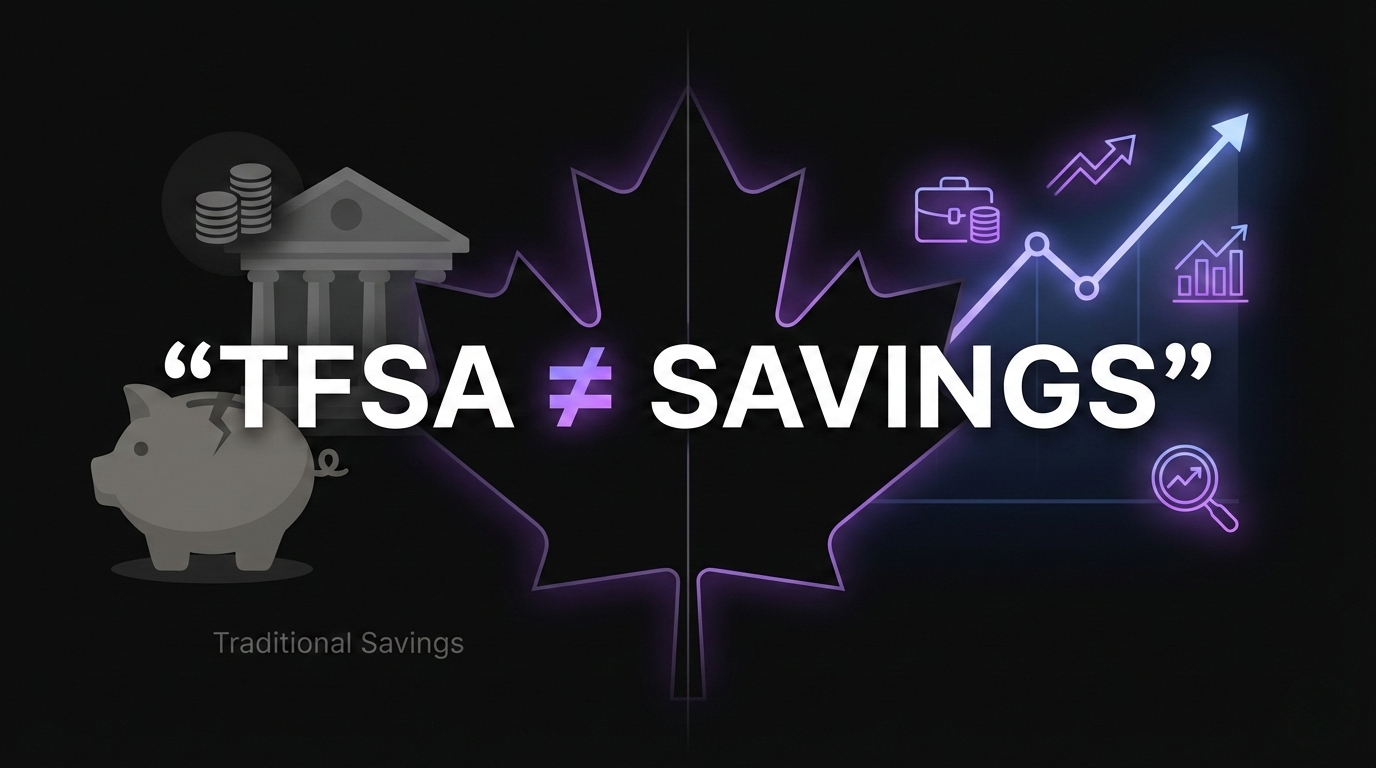
Despite its name, a Tax-Free Savings Account is not simply a savings account. According to the Canada Revenue Agency, the TFSA is “a registered savings account that functions like an investment account” capable of holding cash savings and investments that generate tax-free income. The word “savings” in the name leads many Canadians to treat it as a place to park emergency cash earning minimal interest, a fundamental misunderstanding that costs them significant long-term wealth.
A TFSA is more accurately understood as a tax-sheltered container that can hold virtually any investment you might purchase in a regular brokerage account. The CRA identifies three types of TFSAs: deposit TFSAs (like a regular savings account or GIC held at a bank), annuity contracts with insurance companies, and arrangements in trust where a financial institution holds investments like mutual funds or stocks. That last category, the self-directed TFSA, is where the real wealth-building power lies, allowing Canadians to hold stocks, ETFs, bonds, and other growth assets completely tax-free.
Who can open a TFSA
The eligibility requirements are straightforward. To open a TFSA, you must be a resident of Canada for income tax purposes, possess a valid Social Insurance Number, and be at least 18 years of age. However, in provinces where the legal age to enter a contract is 19, British Columbia, New Brunswick, Newfoundland and Labrador, Northwest Territories, Nova Scotia, Nunavut, and Yukon, you cannot open a TFSA until age 19, though your contribution room from age 18 carries forward.
Unlike RRSPs, no earned income is required to contribute to a TFSA. A student with no job, a stay-at-home parent, or a retiree living on pension income can all contribute to a TFSA up to their available room. New residents to Canada may open a TFSA immediately upon becoming a resident if they are 18 or older, though their contribution room only begins accumulating from their year of residency, not retroactively.
How TFSA taxation works: the triple tax advantage
The TFSA’s tax treatment is elegantly simple and profoundly beneficial. Understanding this taxation model is essential because it reveals why this account should typically be prioritized for high-growth investments.
Contributions are not tax-deductible. Unlike RRSP contributions, money you put into a TFSA has already been taxed as part of your regular income. You receive no tax break in the year of contribution. This means you’re investing with after-tax dollars from the start.
Investment growth is 100% tax-free. Here is where the TFSA’s power becomes apparent. According to the CRA, “any amount contributed as well as any income earned in the account (for example, investment income and capital gains) is generally tax-free, even when it is withdrawn.” Interest, dividends, and capital gains, all of it grows without any tax drag whatsoever. In a taxable account, you would pay taxes annually on interest and dividends, and capital gains taxes when selling appreciated investments. Inside a TFSA, these taxes simply do not exist.
Withdrawals are completely tax-free. When you take money out of your TFSA, nothing needs to be reported on your tax return. The CRA confirms that “most TFSA holders have no tax payable related to their TFSA investments, and no TFSA tax return has to be filed.”
A concrete example of the TFSA’s power
Consider this scenario: You contribute $6,500 to your TFSA in 2023 and invest it in a diversified equity ETF. Over 25 years, with market growth, your investment grows to $50,000. You then withdraw the entire $50,000. Your total tax bill: $0. The $43,500 in investment gains is entirely yours to keep.
In a regular taxable account, you would owe capital gains tax on those gains. At a 50% inclusion rate and a marginal tax rate of 30%, you would pay over $6,500 in taxes. The TFSA lets you keep that money instead.
TFSA contribution rules you must understand
Annual and lifetime contribution limits
The TFSA dollar limit is set annually by the federal government and indexed to inflation, rounded to the nearest $500. Here is the complete historical record:
| Years | Annual Limit |
|---|---|
| 2009–2012 | $5,000 |
| 2013–2014 | $5,500 |
| 2015 | $10,000 |
| 2016–2018 | $5,500 |
| 2019–2022 | $6,000 |
| 2023 | $6,500 |
| 2024–2026 | $7,000 |
For someone who was 18 or older and a Canadian resident since 2009, the cumulative lifetime contribution room through 2025 totals $102,000. With the 2026 limit of $7,000, the total will reach $109,000 by the end of 2026. This represents a remarkable opportunity to shelter over $100,000, plus all future growth, from taxation permanently.
When contribution room begins accumulating
Contribution room starts accumulating in the year you turn 18, provided you are a Canadian resident. The CRA provides a helpful example: “Brayden was eager to open his TFSA, but he didn’t turn 18 until December 21, 2023. On January 4, 2024, he opened a TFSA and contributed $13,500 ($6,500 for 2023 plus $7,000 for 2024, the maximum TFSA dollar limits for those years).”
This means even if you turn 18 on December 31st, you receive the full year’s contribution room. Room accumulates automatically each January 1st whether or not you file taxes, open a TFSA, or make any contributions.
Unused room carries forward indefinitely
If you cannot contribute the full amount in any year, your unused room carries forward. There is no deadline and no penalty for not using your room. A 40-year-old who has never opened a TFSA still has their complete accumulated room available, now totaling $102,000 if they were eligible since 2009.
CRA tracking versus personal tracking
The CRA tracks your contribution room and displays it in My Account for Individuals. However, there is a critical warning from the CRA: “Use your own financial records to calculate your available contribution room, not the information in your CRA account. The TFSA information in your CRA account is only updated once per year in the spring with your transactions of the previous year.”
This delay has caused countless Canadians to accidentally over-contribute. Your financial institution reports your transactions to the CRA by the end of February following each calendar year. The CRA then updates your account information sometime in spring. If you check your CRA account in January after making contributions in December, those contributions will not yet be reflected, potentially showing inflated available room.
Always maintain your own records of all TFSA contributions and withdrawals across all institutions. Use our TFSA calculator to track your contribution room accurately.
Over-contributions and the costly 1% monthly penalty
How the penalty works
If you contribute more than your available TFSA room, you face a 1% tax per month on the excess amount for every month it remains in your account. Unlike RRSPs, which allow a $2,000 grace amount, TFSAs have no buffer, the 1% penalty applies from the very first dollar of over-contribution.
The CRA provides this example: Rosanna has $7,000 of contribution room for 2025. She contributes $4,500 in February and another $4,600 in October, for total contributions of $9,100, exceeding her room by $2,100. Her penalty: 1% × $2,100 × 3 months (October through December) = $63 in tax. If her excess continued into the following year without new room to absorb it, the monthly penalties would continue accumulating.
Common ways Canadians accidentally over-contribute
The CRA identifies several frequent causes of over-contributions:
Re-contributing withdrawals too early. This is the most common mistake. The CRA illustrates with this example: “In 2024, Twyla makes a $7,000 contribution. Later that year, she withdraws $3,000 for a trip. She decides to re-contribute the $3,000 she withdrew. Twyla does not realize that if she returns any of the withdrawn amount before 2025, she will have an excess amount.”
Holding TFSAs at multiple institutions. When you have TFSAs at several banks or brokerages and are not carefully tracking total contributions across all accounts, over-contributions become easy.
Pre-authorized contributions plus additional deposits. If your TFSA has automatic monthly contributions and you make a separate lump-sum contribution without verifying remaining room, you may exceed your limit.
Relying on outdated CRA information. The CRA describes a case where “Moira checks My Account on January 1 to confirm her TFSA contribution room, and the amount displayed is $18,000. In February 2022, Moira makes a $10,000 contribution, which puts her $4,000 in excess.” Her CRA account had not yet reflected previous contributions.
Transferring between institutions incorrectly. If you withdraw from one TFSA and deposit into another TFSA yourself (rather than using a direct transfer), the deposit counts as a new contribution.
How to fix an over-contribution
If you discover an over-contribution, the CRA advises: “Withdraw it as soon as possible. Do not wait for the CRA to inform you.” After withdrawing the excess, your financial institution will report the withdrawal to the CRA. You must then file Form RC243 (Tax-Free Savings Account Return) with Schedule A by June 30 of the following year and pay the penalty owing.
The CRA can waive or reduce penalties if circumstances warrant. You may submit a request explaining why the over-contribution occurred and why it would be fair to cancel or waive all or part of the tax.
Withdrawals and the critical re-contribution timing rules
The flexibility of TFSA withdrawals
One of the TFSA’s greatest advantages is withdrawal flexibility. You can withdraw any amount, at any time, for any reason, completely tax-free. There are no penalties for early withdrawal, no minimum age requirements, no approval needed, and no waiting periods. Simply contact your financial institution to initiate the withdrawal.
Withdrawals do not affect your eligibility for federal income-tested benefits, a significant advantage over RRSP withdrawals, which count as taxable income and can reduce benefits like Old Age Security and the Guaranteed Income Supplement.When withdrawn amounts restore your contribution room
This rule is critical: Withdrawals are added back to your contribution room on January 1 of the following year, not immediately. The CRA states clearly: “Withdrawals made in the current year do not immediately create new available contribution room.”
If you withdraw $10,000 in March, you cannot re-contribute that $10,000 until the following January without risking over-contribution (unless you have other unused room). The CRA example: “In 2023 Cedric withdraws $500 from his account. Even though he makes this withdrawal in 2023, it will not be added back to his contribution room until 2024.”
The crucial difference between withdrawals and transfers
When moving money between TFSAs, understanding this distinction can save you thousands in penalties.
A withdrawal is when you take money out of your TFSA. It reduces your account balance and restores that contribution room the following January 1st. If you then contribute those funds to a different TFSA, this counts as a new contribution against your current room.
A direct transfer (also called a qualifying transfer) is when your financial institution moves funds directly from one TFSA to another on your behalf. The CRA is explicit: “Do not withdraw funds yourself and then contribute them to a different TFSA. This is NOT a direct transfer and it may have serious tax consequences.”
With a direct transfer, there is no impact on contribution room whatsoever, no withdrawal occurs and no contribution occurs. The money simply moves between registered accounts.
If you have $50,000 in a TFSA and want to move it to a different institution, withdrawing and re-depositing yourself would use $50,000 of contribution room. If you have no available room, you would face a 1% monthly penalty on the entire amount until it is removed or absorbed by future room, potentially costing thousands of dollars.
What investments can you hold inside a TFSA
The TFSA as a container, not an investment
Think of a TFSA as a tax-sheltered container that can hold many different types of investments, not as an investment itself. The same TFSA at your bank could hold a simple savings account earning 2%, or it could hold a diversified portfolio of equity ETFs with potential for significant long-term growth. The container is the same; the contents make all the difference.
Qualified investments permitted in TFSAs
The CRA confirms that permitted investments in a TFSA are generally the same as those permitted in an RRSP. The official list includes:
- Cash and savings deposits
- Guaranteed Investment Certificates (GICs)
- Mutual funds and segregated funds
- Securities listed on designated stock exchanges, including shares of corporations, warrants, options, and units of exchange-traded funds (ETFs)
- Government and corporate bonds
- Canada Savings Bonds and provincial savings bonds
- Real estate investment trusts (REITs) listed on designated exchanges
- Certain shares of small business corporations
Investments that are not permitted
Prohibited investments are those with a close connection to the TFSA holder, for example, shares in a corporation where you own 10% or more, or debts owed by non-arm’s length parties. Acquiring a prohibited investment triggers a 50% tax on the fair market value of the investment.
Non-qualified investments include anything not on the approved list, such as physical real estate, investments not listed on designated exchanges, or certain private company shares. The same 50% tax applies.
The day trading risk: carrying on a business
The CRA warns that “TFSA holders who invest with the frequency and experience of a professional trader may have their account de-registered and any income earned taxed as a business.” If the CRA determines your TFSA is carrying on a business rather than investing, the trust becomes taxable on all income and capital gains.
Factors that may indicate business activity include high trading frequency, time spent on trading activities, specialized knowledge, intention to profit from short-term trading, and experience in securities markets. While occasional trading is generally acceptable, treating your TFSA as a day-trading account creates significant tax risk.
Strategic investment selection for your TFSA
Why high-growth assets belong in a TFSA
Because all growth inside a TFSA is tax-free, the account’s value increases most when sheltering investments with the highest expected growth. A dollar of tax-free growth is worth more than a dollar of taxable growth, so maximize what you’re sheltering.
If you have $50,000 earning 8% annually in a TFSA and $50,000 earning 2% in a taxable account, the high-growth investment generates $4,000 per year tax-free while the low-growth investment generates $1,000 taxable. Swapping their locations would mean sheltering only $1,000 from taxes while paying taxes on $4,000 of gains, a costly allocation error.
This logic suggests prioritizing equities, growth ETFs, and other assets with high expected returns for your TFSA, while keeping lower-return fixed income in taxable accounts or RRSPs where appropriate.
Canadian versus US stocks in a TFSA
Both Canadian and US stocks listed on designated exchanges are qualified investments for TFSAs. However, a critical difference exists for dividend taxation. The CRA notes that “if dividend income from a foreign country is paid to a TFSA, the dividend income could be subject to foreign withholding tax.”
US dividends paid to a TFSA are subject to 15% US withholding tax under the Canada-US Tax Treaty. Unlike with RRSPs, which the IRS recognizes as tax-exempt retirement accounts, TFSAs receive no US tax treaty protection. This withholding tax is not recoverable and represents a permanent cost.
For investors holding significant US dividend-paying stocks, this creates a consideration: Canadian dividends and US growth stocks (which pay minimal dividends) may be better suited for TFSAs, while US dividend stocks might be more efficiently held in RRSPs.
The dividend and growth tradeoff
Canadian dividends received inside a TFSA face no Canadian tax, a clear advantage. However, if you are in a low tax bracket, the dividend tax credit available for Canadian dividends held in taxable accounts means the effective tax rate can be very low or even negative. For high-income earners, the TFSA’s complete tax shelter is more valuable.
Capital gains assets with potential for significant appreciation are generally excellent TFSA holdings because you eliminate the capital gains tax entirely, tax that would otherwise apply when selling in a taxable account.
Common TFSA myths and costly mistakes to avoid
Myth: “The TFSA is just a savings account”
This misconception costs Canadians billions in foregone tax-free growth. A TFSA holding a high-interest savings account at 4% will grow to approximately $7,800 from a $6,500 contribution over 10 years. The same contribution in a diversified equity ETF averaging 7% would grow to approximately $12,800. Both are tax-free, but the growth-oriented approach shelters an additional $5,000 from taxation on that single contribution.
For long-term goals, treating your TFSA as an investment account, not just a savings account, is essential.
Myth: “I lose my room forever when I withdraw”
This is false. Withdrawals restore to your contribution room on January 1 of the following year. If you withdraw $20,000 in July, that $20,000 becomes available contribution room again the next January, in addition to that year’s new annual limit.
The confusion arises because the room does not return immediately, leading to the next costly mistake.
Mistake: Re-contributing withdrawn funds in the same year
If you have no unused contribution room and you withdraw $10,000 in March, you cannot re-contribute that $10,000 until January of the following year. Doing so creates an over-contribution subject to the 1% monthly penalty. Wait for the calendar year to turn before replacing withdrawn amounts unless you have verified unused room available.
Myth: “The CRA automatically prevents over-contributions”
The CRA does not block over-contributions in real-time. Your financial institution will accept your contribution regardless of whether you have room. The CRA only learns of your contributions months later when institutions file annual reports. By then, you may have accumulated months of 1% penalties.
Personal tracking of all contributions and withdrawals across all TFSAs is your responsibility and your protection.
Myth: “I shouldn’t invest aggressively in a TFSA”
The opposite is strategically sound. Because all growth is tax-free, sheltering high-growth investments provides the greatest benefit. A conservative approach might be appropriate based on your risk tolerance and timeline, but it should not be based on the mistaken belief that TFSAs are meant for conservative investments.
The CRA permits the same investments in a TFSA as in an RRSP, stocks, ETFs, options, REITs, and more. The question is your investment strategy, not the account’s capability.
Learn more about developing your personal financial strategy with our LoonieLens mission and approach to financial freedom.
Conclusion: maximizing your TFSA opportunity
The Tax-Free Savings Account represents a generational wealth-building opportunity that the Canadian government has provided. With $102,000 of lifetime contribution room available through 2025 for those eligible since 2009, and $7,000 added each year, the potential for tax-free wealth accumulation is substantial.
The key insights for TFSA success are straightforward: treat your TFSA as an investment account rather than a simple savings vehicle; prioritize high-growth investments that benefit most from tax-free compounding; track your contributions meticulously to avoid costly over-contribution penalties; understand that withdrawals restore room only on January 1 of the following year; and use direct transfers when moving between institutions to preserve your contribution room.
For young Canadians, the TFSA often deserves priority over the RRSP due to lower current tax brackets and the account’s flexibility. If you just landed your first job and aren’t sure where to start, our guide on the first 5 financial moves for new Canadian earners walks through how the TFSA fits into the full picture. For first-time home buyers, consider also opening a First Home Savings Account (FHSA) which offers similar tax-free growth plus tax-deductible contributions. For retirees, the TFSA provides tax-free supplemental income that does not affect government benefits. For everyone, the TFSA offers something rare in personal finance, a completely tax-free environment for investment growth that remains accessible throughout your lifetime with no withdrawal restrictions or age-based rules.
The earlier you begin maximizing contributions and investing for growth, the more powerful the tax-free compounding becomes. For a 25-year-old contributing $7,000 annually into a growth portfolio, the account could reasonably exceed $1 million by traditional retirement age, with every dollar of that growth sheltered permanently from taxation.
Additional Resources
For more detailed information directly from the Canada Revenue Agency:
- Tax-Free Savings Account (TFSA) - Official CRA Main Page
- TFSA Guide for Individuals (RC4466)
- Calculate Your TFSA Contribution Room
This article is for educational purposes only and does not constitute financial advice. All information is sourced from official Canada Revenue Agency publications. For personalized financial guidance, consult with a qualified financial advisor.