A Registered Retirement Savings Plan (RRSP) is a Canadian retirement account where contributions are tax-deductible and investment growth is tax-deferred until withdrawal. The 2026 contribution limit is $33,810 or 18% of your 2025 earned income, whichever is less, with contributions reducing your taxable income dollar-for-dollar.
The RRSP represents Canada’s cornerstone retirement planning vehicle, offering a government-sanctioned framework to build wealth while deferring taxation. Unlike the TFSA’s tax-free growth, the RRSP provides an immediate tax deduction on contributions, making it particularly powerful for Canadians in higher tax brackets who expect lower income in retirement. Since its introduction in 1957, the RRSP has enabled millions of Canadians to build retirement security through tax-deferred compounding, with every dollar contributed reducing current-year taxes while accumulating value for the future. Understanding how to maximize this account properly can mean the difference between a comfortable retirement and financial struggle in your later years.
What is an RRSP and how the tax deferral works
A Registered Retirement Savings Plan is fundamentally different from a TFSA or regular investment account in one critical way: contributions are tax-deductible, growth is tax-deferred, and withdrawals are fully taxable. According to the Canada Revenue Agency, an RRSP is “a retirement savings plan that you establish, that the CRA registers, and to which you or your spouse or common-law partner contribute.”
The CRA identifies several types of RRSPs: individual RRSPs that you open yourself, spousal or common-law partner RRSPs where one partner contributes for the other, group RRSPs offered through employers, and pooled registered pension plans (PRPPs) for those without workplace pensions. Each serves the same fundamental purpose: sheltering retirement savings from immediate taxation.
The three-stage taxation model
Stage 1: Contribution = immediate tax deduction. Every dollar you contribute to your RRSP reduces your taxable income by one dollar. If you earn $80,000 and contribute $10,000 to your RRSP, you only pay tax on $70,000 of income. At a 30% marginal tax rate, that $10,000 contribution generates a $3,000 tax refund.
Stage 2: Growth = completely tax-deferred. While your money remains inside the RRSP, all interest, dividends, and capital gains accumulate without any tax whatsoever. A dollar of growth this year compounds into more growth next year, unimpeded by annual taxation. This tax deferral creates significantly more powerful compounding than a taxable account.
Stage 3: Withdrawal = fully taxable as income. When you withdraw from your RRSP, whether at age 45 or 75, the entire amount is added to your income for that year and taxed at your marginal rate. The CRA is clear: “You generally have to pay tax when you receive payments from the plan.”
A concrete example of RRSP taxation
Consider this scenario: You contribute $15,000 to your RRSP while earning $95,000 annually, placing you in the 29% federal tax bracket. Your immediate tax savings: $4,350. That money grows to $125,000 over 25 years through tax-deferred compounding. In retirement, you withdraw $25,000 annually while earning only CPP and OAS, placing you in the 20.5% bracket. You pay $5,125 in tax on that year’s withdrawal, far less than the taxes avoided during contribution years.
The math works because you defer tax from your high-earning years to your lower-income retirement years, keeping significantly more money working for you throughout.
RRSP contribution rules and limits for 2026
The 18% rule and annual maximum
Your RRSP contribution room for 2026 is calculated as the lesser of:
- 18% of your 2025 earned income, OR
- $33,810 (the 2026 RRSP dollar limit)
This means a Canadian who earned $100,000 in 2025 generates $18,000 of new RRSP room for 2026. Someone earning $300,000 generates the same room as someone earning $188,000, both hitting the $33,810 ceiling.
The CRA defines earned income as employment earnings, net business income, rental income, disability payments from CPP/QPP, and taxable spousal support received, minus union dues, employment expenses, business losses, rental losses, and deductible spousal support paid.
Investment income, CERB payments, EI benefits, pension income, RRSP withdrawals, and capital gains do not create RRSP room. Only active income from work generates contribution capacity.
RRSP deduction limit versus contribution room
The CRA distinguishes between contribution room and deduction limit. Your RRSP deduction limit equals:
Your unused RRSP room from previous years Plus new room generated from last year’s income (18% or dollar limit) Plus any pension adjustment reversals (PARs) Minus your pension adjustment (PA) from employer pensions Minus any past service pension adjustments (PSPAs)
The pension adjustment reduces your RRSP room when you participate in an employer pension plan, preventing double-dipping on retirement savings tax benefits. If your employer contributes $8,000 to your defined benefit pension in 2025, your 2026 RRSP room decreases by approximately that amount.
When contribution room begins accumulating
RRSP contribution room starts accumulating the year you turn 18, regardless of whether you file taxes or open an account. Room accumulates automatically each year based on your earned income, carries forward indefinitely if unused, and appears on your Notice of Assessment following each tax return.
A 30-year-old who never contributed to an RRSP still has every dollar of contribution room generated from age 18 onwards. There is no deadline and no penalty for not using your room in any given year.
The critical March deadline
March 3, 2025, is the deadline for RRSP contributions that can be deducted on your 2024 tax return. The CRA states: “March 3, 2025, is the deadline for contributing to an RRSP for the 2024 tax year.”
This 60-day grace period allows Canadians to make contributions in early 2025 and claim them against 2024 income, a valuable planning opportunity when you receive late-year income information or bonuses.
Understanding the RRSP deduction: contributions versus deductions
A critical but frequently misunderstood concept: you can contribute to an RRSP without deducting the contribution immediately. The CRA permits strategic deferral of RRSP deductions to future years when your tax rate may be higher.
Example: Strategic deduction deferral
Marie earns $52,000 in 2024, placing her in the 20.5% federal bracket. She contributes $8,000 to her RRSP in early 2025 for the 2024 tax year but only deducts $3,000 on her 2024 return, saving $615 in taxes. The remaining $5,000 remains as an unused RRSP contribution she can deduct in 2025, 2026, or any future year.
In 2025, Marie receives a promotion and earns $105,000, jumping to the 26% bracket. She deducts her carried-forward $5,000, saving $1,300 instead of the $1,025 she would have saved in 2024. By deferring the deduction, she captured an extra $275 in tax savings.
The CRA confirms: “You do not have to claim the full amount of your deductible RRSP contributions for 2024. The contributions you do not claim for 2024 may be carried forward and claimed for future years.”
Track unused contributions carefully using Schedule 7, as these amounts reduce available contribution room even though not yet deducted.
Spousal RRSPs: income splitting for retirement
A spousal or common-law partner RRSP is one of Canada’s most effective income-splitting tools, allowing higher-earning spouses to contribute to an RRSP in their partner’s name, claim the deduction themselves, yet have withdrawals taxed in the lower-earning spouse’s hands.
How spousal RRSPs work
According to the CRA’s spousal RRSP guidance, contributions to your spouse’s or common-law partner’s RRSP reduce your RRSP deduction limit, not theirs. The receipt shows you as the contributor and your spouse as the annuitant.
The total you can deduct for contributions to your own RRSP and your spouse’s RRSP cannot exceed your RRSP deduction limit. If you have $20,000 of room, you could contribute $12,000 to your RRSP and $8,000 to your spouse’s, or any combination not exceeding $20,000.
The three-year attribution rule
The critical restriction: if your spouse withdraws funds from their spousal RRSP within three calendar years of your last contribution, you must include the withdrawal in your income, not your spouse.
The CRA explains the attribution period: “If you contributed to your spouse’s or common-law partner’s RRSPs in 2022, 2023, or 2024, you may have to include in your 2024 income all or part of amounts your spouse or common-law partner received in 2024 from any of their spousal or common-law partner RRSPs.”
To ensure withdrawals are taxed in the annuitant spouse’s hands, the contributing spouse must not contribute to any spousal RRSP in the withdrawal year or the two preceding calendar years.
After age 71
Even after you turn 71 and can no longer contribute to your own RRSP, the CRA permits spousal RRSP contributions until December 31 of the year your spouse turns 71, provided you have RRSP deduction room.
The Home Buyers’ Plan (HBP): borrowing from your RRSP
The HBP allows first-time home buyers to withdraw funds from RRSPs tax-free to purchase or build a qualifying home, with structured repayment over 15 years.
Current HBP limits and conditions
As of April 16, 2024, the withdrawal limit increased to $60,000 per person. Couples where both qualify as first-time buyers can collectively withdraw $120,000 tax-free.
To participate in the HBP, the CRA requires:
- You must be a Canadian resident when withdrawing
- You must be considered a first-time home buyer (have not owned a home you occupied as your principal residence in the four years before withdrawal)
- You must have a written agreement to buy or build a qualifying home before the withdrawal
- You must occupy the home as your principal residence within one year of buying or building it
- You must buy or build the home before October 1 of the year following your withdrawal
Contributions made to your RRSP less than 90 days before withdrawal under the HBP cannot be deducted for any year. This prevents Canadians from making last-minute contributions, claiming the deduction, and immediately withdrawing tax-free.
HBP repayment rules
You have 15 years to repay withdrawn amounts to your RRSP, with repayments starting in the second year after withdrawal—except for withdrawals made between January 1, 2022, and December 31, 2025. The CRA introduced temporary relief deferring the start of repayment to the fifth year for these participants.
Each year, you must repay at least 1/15 of the amount withdrawn. If you fail to make the minimum repayment, the shortfall is added to your taxable income for that year. You can repay more than the minimum to accelerate repayment and reduce future obligations.
Repayments are not RRSP contributions for deduction purposes. You cannot claim an RRSP deduction for HBP repayments, but they also do not reduce your available RRSP contribution room.
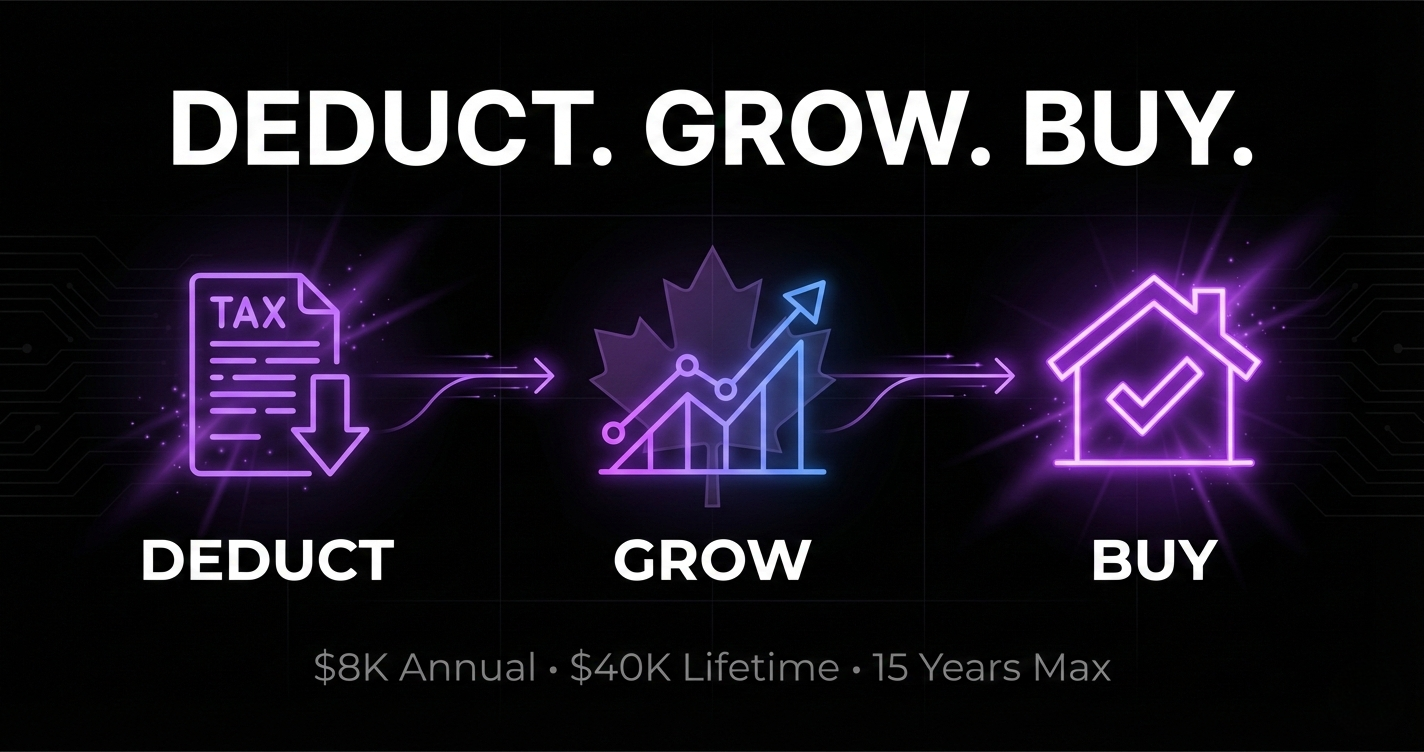
FHSA Guide 2026: Complete First Home Savings Account Rules
Learn about the FHSA, which offers tax-deductible contributions AND tax-free withdrawals for first-time home buyers.
The Lifelong Learning Plan (LLP): funding education
The LLP permits withdrawals from RRSPs to finance full-time training or education for yourself or your spouse or common-law partner, with tax-free withdrawals and structured repayment.
LLP limits and conditions
The CRA allows withdrawals of up to $10,000 per calendar year and $20,000 total for each participation period.
To qualify:
- You must be a Canadian resident
- You cannot participate after the year you turn 71
- The student (you or your spouse) must be enrolled full-time in a qualifying educational program at a designated educational institution
- The student must remain enrolled at least three months in the year of withdrawal or by March of the following year
Students qualifying for the disability tax credit may participate with part-time enrollment. The LLP cannot be used for children’s education; it is limited to you or your spouse.
LLP repayment structure
You have 10 years to repay withdrawn amounts, repaying at least 1/10 annually. The CRA determines when repayment begins by checking if you remain a qualifying student for at least three months during the year. If you meet this condition every year, repayment starts in the fifth year after first withdrawal. If you fail to meet the condition for two consecutive years, repayment begins in the second of those years.
Like HBP repayments, LLP repayments do not count as deductible RRSP contributions but also do not use contribution room. Failure to make the minimum annual repayment adds the shortfall to your taxable income.
Types of RRSPs and how they differ
Individual RRSPs
The standard RRSP you open with a financial institution. You control contributions, investments, and withdrawals. Your RRSP issuer may be a bank, credit union, trust company, or insurance company.
Self-directed RRSPs are a subset allowing you to control specific investments rather than selecting pre-built funds. The CRA notes that self-directed RRSPs let you “control the assets and make the investment decisions yourself.” Securities must be held in the RRSP’s name, not yours personally.
Spousal or common-law partner RRSPs
Discussed extensively above. These are individual RRSPs where one spouse contributes for the other, enabling income splitting during retirement.
Group RRSPs
Offered through employers, group RRSPs facilitate payroll deductions with contributions going directly from your paycheque to your RRSP. Employers may match contributions up to certain limits. Despite being employer-administered, group RRSPs are your personal accounts, portable when changing jobs.
Pooled Registered Pension Plans (PRPPs)
PRPPs are retirement savings options for individuals without workplace pension plans. The CRA describes PRPPs as retirement savings plans to which you or your employer, or both, can contribute, with income usually exempt from tax while remaining in the plan.
PRPP contributions follow the same rules as RRSP contributions, reducing your RRSP deduction limit. Employer contributions to PRPPs are reported separately on your tax return.
RRSP withdrawal rules and withholding tax
Standard RRSP withdrawals
When you withdraw funds from your RRSP at any age, the entire withdrawal is added to your income for the year and taxed at your marginal rate. Additionally, your financial institution withholds tax at source.
The CRA specifies withholding tax rates for Canadian residents:
| Withdrawal Amount | Withholding Tax Rate (except Quebec) |
|---|---|
| Up to $5,000 | 10% |
| $5,001 to $15,000 | 20% |
| Over $15,000 | 30% |
Quebec residents face provincial withholding in addition to federal withholding. For withdrawals up to $5,000, Quebec withholds 19%; for $5,001 to $15,000, 24%; and over $15,000, 29%.
Example: Withholding versus actual tax
Denise withdraws $18,000 from her RRSP in 2025. Her financial institution withholds 30%, or $5,400, remitting it to the CRA. On her 2025 tax return, Denise reports $18,000 of RRSP income. With other income totaling $70,000, her marginal rate on the withdrawal is 26%. Her actual tax on the $18,000 withdrawal is $4,680. The $5,400 already withheld exceeds this, so Denise receives a $720 refund. Had she been in the 33% bracket, she would owe an additional $1,540 beyond the withholding.
Withdrawals exempt from withholding tax
The CRA does not require withholding on:
- Withdrawals under the Home Buyers’ Plan (up to $60,000)
- Withdrawals under the Lifelong Learning Plan (up to the annual limits)
- Direct transfers from one RRSP to another RRSP
- Transfers from RRSP to RRIF
- Amounts used to purchase an eligible annuity
These exempt withdrawals or transfers still create tax obligations when income ultimately flows from the plan, except for HBP and LLP withdrawals if properly repaid.
RRSP options when you turn 71
December 31 of the year you turn 71 is the absolute deadline for RRSP contributions. The CRA mandates: “December 31 of the year you turn 71 years old is the last day that you can contribute to your RRSPs.”
By this date, you must decide how to handle your accumulated RRSP funds. The CRA offers three options:
Option 1: Convert to a Registered Retirement Income Fund (RRIF)
The most common choice. A RRIF continues tax-deferred growth like an RRSP but requires annual minimum withdrawals starting the year after conversion. Minimum withdrawal percentages begin at approximately 5.28% at age 72 and gradually increase, reaching 20% at age 95 and beyond.
You can elect to base minimum withdrawals on your spouse’s age if they are younger, reducing mandatory withdrawals and allowing more tax-deferred growth.
RRIF conversions trigger no immediate tax. The CRA confirms: “Your RRSP issuer will not withhold tax on amounts that are transferred directly to a RRIF.” Tax is paid only on withdrawals, with the minimum amount subject to no withholding but amounts exceeding the minimum facing withholding tax.
Option 2: Purchase an annuity
An annuity provides guaranteed lifetime income. You transfer your RRSP funds to an insurance company, which promises fixed payments for life (or for a specified period). Payments are fully taxable as income.
Annuities eliminate investment risk and provide certainty but sacrifice flexibility and growth potential. If you die early, remaining funds may be lost unless you purchase a joint-and-survivor or guaranteed-period annuity.
As with RRIF conversions, purchasing an annuity with RRSP funds creates no immediate tax liability.
Option 3: Withdraw as a lump sum
You can withdraw your entire RRSP as cash. The full amount is added to your income for the year, often creating a substantial tax bill. For a $400,000 RRSP withdrawn in one year, the withdrawal alone could push you into the top tax bracket, resulting in taxes exceeding $150,000.
This option makes sense only in rare circumstances, such as terminal illness with minimal remaining life expectancy or when total RRSP value is small.
If you take no action
If you do not convert your RRSP by December 31 of the year you turn 71, the CRA deregisters the plan and considers the entire fair market value as income for the following year. Withholding tax is deducted, and the net proceeds are paid to you. This forced deregistration typically creates an enormous tax bill and is almost never beneficial.
RRSP versus TFSA versus FHSA: strategic comparison
Canadians often ask which account to prioritize. The answer depends on your current tax rate, expected retirement tax rate, investment timeline, and goals.
Tax treatment comparison
| Feature | RRSP | TFSA | FHSA |
|---|---|---|---|
| Contribution tax treatment | Tax-deductible | No deduction | Tax-deductible |
| Growth tax treatment | Tax-deferred | Tax-free | Tax-deferred |
| Withdrawal tax treatment | Fully taxable | Tax-free | Tax-free (qualifying withdrawal) |
| Contribution limit 2026 | $33,810 or 18% of income | $7,000 | $8,000/year ($40,000 lifetime) |
| Unused room carryforward | Yes, indefinitely | Yes, since 2009 | Yes, max 15 years |
When to prioritize RRSP over TFSA
Prioritize RRSP when:
- Your current marginal tax rate exceeds your expected retirement tax rate by at least 5-10 percentage points
- You are in the 26% bracket or higher and expect to retire in the 20.5% bracket or lower
- Employer matching is available through a group RRSP (free money always wins)
- You need to reduce current-year income to preserve income-tested benefits like CCB
- You are over the TFSA contribution limit and need additional tax-sheltered space
Prioritize TFSA when:
- Your current tax rate is low (20.5% bracket or below) and unlikely to decrease significantly in retirement
- You anticipate needing flexible access to funds before retirement without tax consequences
- You have maximized RRSP room and seek additional tax-free growth
- You want complete withdrawal flexibility without minimum withdrawal requirements at 72

TFSA Guide 2026: Complete Tax-Free Savings Account Rules
Learn how TFSAs work and when to prioritize them over RRSPs in your financial strategy.
FHSA as the hybrid solution
For first-time home buyers, the FHSA offers the best of both worlds: RRSP-style tax deductions on contributions with TFSA-style tax-free withdrawals for qualifying home purchases. Max out FHSA contributions before using RRSP room for home purchases via the HBP.
Common RRSP mistakes and how to avoid them
Mistake: Over-contributing beyond the $2,000 grace amount
The CRA allows a $2,000 lifetime cushion for over-contributions without penalty if you are 18 or older. Contributions exceeding your RRSP deduction limit by more than $2,000 face a 1% monthly penalty tax on the excess.
The CRA warns: “Generally, you have to pay a tax of 1% per month on your contributions that exceed your RRSP deduction limit by more than $2,000.”
Track contributions across all institutions carefully. Over-contributions arise frequently when Canadians have multiple RRSPs, forget about automated contributions, or misread their Notice of Assessment.
Mistake: Not deferring deductions strategically
Contributing $15,000 while earning $55,000 (20.5% bracket) and immediately deducting it saves $3,075 in taxes. If you expect promotion to the 26% bracket next year, carrying forward $10,000 of the deduction saves an extra $550.
Mistake: Withdrawing from spousal RRSPs too soon
Withdrawing from a spousal RRSP before three full calendar years have passed since the last contribution attributes income to the contributor. Wait until the fourth calendar year to ensure withdrawals are taxed in the annuitant’s hands.
Mistake: Ignoring RRSP options at 71
Allowing your RRSP to deregister by default at 71 creates maximum taxation. Converting to a RRIF or purchasing an annuity before December 31 of your 71st year avoids forced deregistration and preserves tax deferral.
Mistake: Treating RRSP withdrawals as “free money”
Every RRSP withdrawal reduces retirement security, triggers immediate taxation, and permanently eliminates that contribution room. Unlike TFSAs, withdrawn RRSP amounts do not restore contribution room. Early withdrawals sacrifice decades of tax-deferred compounding.
When to prioritize RRSP contributions: strategic considerations
Max out RRSPs first if:
- Your marginal tax rate is 26% or higher and you expect it to be 20.5% or lower in retirement
- Your employer matches contributions dollar-for-dollar or offers any matching program
- You are 50+ and have limited time before retirement to accumulate savings
- You need to reduce taxable income below OAS clawback thresholds (starting at $90,997 in 2026)
Consider TFSAs or FHSAs first if:
- You are under 30 and in the 20.5% bracket with uncertain career trajectory
- You anticipate needing funds before retirement for major purchases
- You are already contributing sufficient amounts to employer pension plans
- Your retirement income (CPP, OAS, employer pension, RRIF minimums) will likely equal or exceed your working income
The optimal strategy for most Canadians involves both accounts: RRSP contributions while in high brackets, TFSA contributions when tax rates are low or RRSP room is exhausted, and FHSA maximization for first-time buyers. If you are at the start of your earning journey, the first 5 financial moves for new Canadian earners outlines how to sequence these accounts before making RRSP contributions a priority.
Conclusion: leveraging the RRSP for retirement security
The Registered Retirement Savings Plan remains Canada’s most powerful wealth-building vehicle for those who understand and apply its rules strategically. With $33,810 of contribution room available in 2026 or 18% of your 2025 earned income, the opportunity to defer substantial taxes while building retirement wealth is significant.
The key insights for RRSP success are straightforward: contribute when your tax rate is high and defer deductions if necessary; convert to RRIF or purchase annuity before December 31 of the year you turn 71 to avoid forced deregistration; understand that spousal RRSPs enable powerful income splitting if managed with the three-year attribution rule in mind; utilize HBP and LLP strategically for major life goals while maintaining repayment discipline; and track your deduction limit carefully across all accounts to avoid over-contribution penalties.
For Canadians in higher tax brackets expecting lower retirement income, the RRSP’s tax deferral creates wealth accumulation that far exceeds taxable accounts. For those in lower brackets or expecting similar retirement income, the TFSA’s tax-free growth may be superior. For most Canadians, the answer is leveraging both strategically based on life stage and income trajectory.
The earlier you begin maximizing contributions and investing for growth within your RRSP, the more powerful the tax-deferred compounding becomes. For a 30-year-old contributing the maximum annually into a growth portfolio, the account could reasonably exceed $2 million by traditional retirement age at 65, with disciplined tax planning minimizing withdrawals during high-earning years and spreading them across lower-income retirement years.
Additional Resources
For more detailed information directly from the Canada Revenue Agency:
- Registered Retirement Savings Plan (RRSP) - Canada.ca
- T4040 RRSPs and Other Registered Plans for Retirement - Canada.ca
- Contributing to an RRSP, PRPP or SPP - Canada.ca
- Contributing to your spouse's or common-law partner's RRSPs - Canada.ca
- Withdrawing from spousal or common-law partner RRSPs - Canada.ca
- The Home Buyers' Plan - Canada.ca
- How to participate in the Home Buyers' Plan - Canada.ca
- Lifelong Learning Plan - Canada.ca
- Participating in the Lifelong Learning Plan - Canada.ca
- Repayments to your RRSP under the Lifelong Learning Plan - Canada.ca
- RRSP options when you turn 71 - Canada.ca
- Receiving income from an RRSP - Canada.ca
- Tax rates on withdrawals - Canada.ca
- Making withdrawals - Canada.ca
- Important dates for RRSPs, HBP, LLP, FHSAs and more - Canada.ca
This article is for educational purposes only and does not constitute financial advice. All information is sourced from official Canada Revenue Agency publications current as of January 2026. Tax rules and limits are subject to change. For personalized financial guidance, consult with a qualified financial advisor.