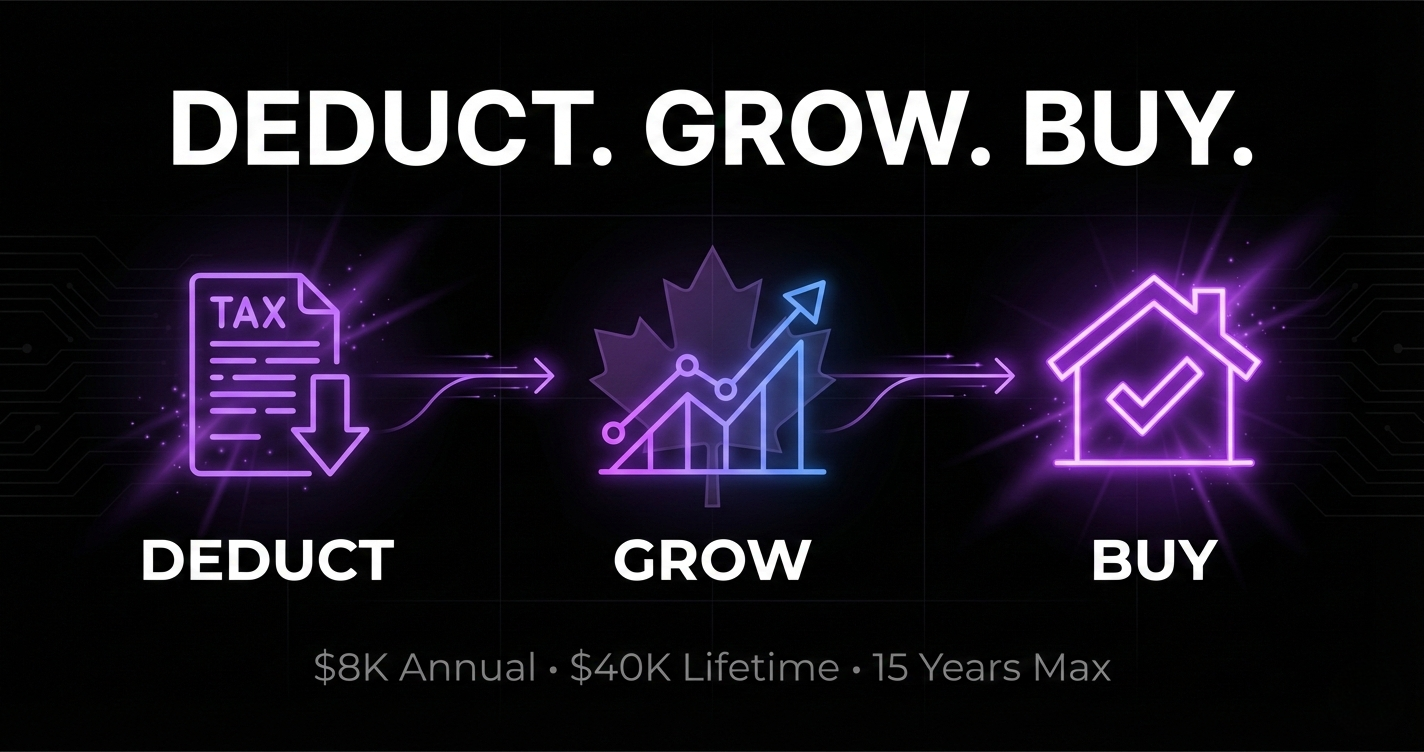
The First Home Savings Account represents one of Canada’s most powerful tax-advantaged savings vehicles, combining the best features of both RRSPs and TFSAs specifically for first-time homebuyers. Canadians can contribute up to $8,000 annually and $40,000 over their lifetime, deduct those contributions from taxable income, grow investments tax-free, and withdraw the funds completely tax-free when purchasing a qualifying first home. The FHSA became available on April 1, 2023, and by the end of that year, 739,000 Canadians had already opened accounts holding a combined $2.79 billion.
What the FHSA is and its core purpose
The Canada Revenue Agency defines the FHSA as “a registered plan which allows you, if you are a first-time home buyer, to save to buy or build a qualifying first home tax-free (up to certain limits).” The account uniquely combines benefits from two existing registered plans: “Like a Registered Retirement Savings Plan (RRSP), contributions would be tax-deductible, and withdrawals to purchase a first home, including from investment income, would be non-taxable, like a Tax-Free Savings Account (TFSA).”
The FHSA was announced in Budget 2022 on April 7, 2022, enacted through Bill C-32 which received Royal Assent on December 15, 2022, and became available to Canadians on April 1, 2023. One significant change from the original proposal: the enacted rules now permit individuals to use both the FHSA and the Home Buyers’ Plan together for the same home purchase, the original design had prohibited this.
Complete eligibility requirements
To open an FHSA, you must meet all of the following criteria at the time of account opening:
Age requirements
You must be at least 18 years old and no older than 71 as of December 31 of the year you open the FHSA. In provinces and territories where the legal age to enter into contracts is 19 (British Columbia, New Brunswick, Newfoundland and Labrador, Northwest Territories, Nova Scotia, Nunavut, and Yukon), you must wait until age 19.
Residency
You must be a resident of Canada at the time you open the account. If you become a non-resident after opening, you can continue participating normally with one exception: you cannot make a qualifying withdrawal while you are a non-resident.
First-time home buyer definition
This is the most complex requirement. You qualify if you did not live in a qualifying home (or what would be a qualifying home if located in Canada) as your principal place of residence that you owned or jointly owned in the current calendar year or in the previous four calendar years. Additionally, one of the following must be true: (a) you did not live in a qualifying home owned by your spouse or common-law partner during the same period, or (b) you do not have a spouse or common-law partner at the time you open the account.
What constitutes a qualifying home
A housing unit located in Canada, including single-family homes, semi-detached homes, townhouses, mobile homes, condominium units, apartments in duplexes through fourplexes or apartment buildings, and shares in a co-operative housing corporation that entitle you to ownership with an equity interest. A share providing only a right to tenancy does not qualify. Ownership is defined broadly to include beneficial ownership but excludes rights to acquire less than 10% of a qualifying home.
Contribution rules: limits, room accumulation, and carry-forward
The FHSA contribution structure involves an annual limit of $8,000 and a lifetime limit of $40,000. Critically, contribution room only begins accumulating when you actually open your first FHSA, unlike the TFSA, which accumulates room automatically from age 18. “Unlike a tax-free savings account, your FHSA participation room only starts when you officially open your first account through your financial institution.”
Carry-forward rules
You can carry forward unused participation room up to a maximum of $8,000 per year. This means the maximum you can contribute in any single year is $16,000 ($8,000 annual room plus $8,000 carried forward). For example, if you open an FHSA in 2024 and contribute nothing, your 2025 participation room becomes $16,000.
Important distinctions from RRSPs
Contributions made to your FHSA during the first 60 days of the year cannot be deducted on your previous year’s tax return, unlike RRSP contributions. If you make an FHSA contribution in January 2025, you can only claim it on your 2025 return, not your 2024 return.
RRSP transfers
You can transfer funds directly from your RRSP to your FHSA without immediate tax consequences, but these transfers count against your FHSA participation room and are not tax-deductible (since you already received a deduction when contributing to the RRSP). The transfer also does not restore your RRSP contribution room. Use Form RC720 for these transfers.
Tax treatment: triple tax advantage
The FHSA provides a rare “triple tax advantage” that combines benefits normally available only separately:
Tax-deductible contributions
“Contributions that you make to your first home savings accounts (FHSAs) are generally deductible on your income tax and benefit return for the year of the contribution or a future year, similar to registered retirement savings plan (RRSP) contributions.” Enter the deduction on line 20805 of your tax return and complete Schedule 15.
Deduction carry-forward
You can carry forward unused deductions indefinitely, even beyond the closure of your FHSAs. This strategy can be valuable if you expect to be in a higher tax bracket in future years: “If your taxable income is expected to increase in future years, it may be more beneficial for you to claim all or part of the FHSA contributions you made in 2024 as a deduction in future years.”
Tax-free growth
“Generally, any income earned in the FHSA (for example, interest, dividends, or capital gains) is not taxable while it remains in the account.” Investment income and capital gains do not count toward your participation room. However, investment losses within the FHSA cannot be claimed as deductions.
Tax-free qualifying withdrawals
When you make a qualifying withdrawal to purchase a first home, the entire amount, including all investment growth, comes out completely tax-free with no repayment requirement.
Qualifying withdrawals: requirements for tax-free home purchase
To make a tax-free qualifying withdrawal, you must meet all of the following conditions simultaneously:
First-time buyer status at withdrawal: You did not live in a qualifying home as your principal place of residence that you owned or jointly owned at any time in the current calendar year before the withdrawal (except the 30 days immediately before the withdrawal) or the previous four calendar years.
Written agreement: You must have a written agreement to buy or build a qualifying home with the acquisition or construction completion date before October 1 of the year following the withdrawal date.
Timing of acquisition: You must not have acquired the qualifying home more than 30 days before making the withdrawal.
Continuous residency: You must be a resident of Canada from the time of your first qualifying withdrawal until the earlier of acquiring the home or your death.
Occupancy intention: You must occupy or intend to occupy the qualifying home as your principal place of residence within one year after buying or building it.
Documentation: You must complete Form RC725 (Request to Make a Qualifying Withdrawal from your FHSA) and provide it to your FHSA issuer.
Post-withdrawal timeline
You must close all of your FHSAs by December 31 of the year following your first qualifying withdrawal. Contributions made after your first qualifying withdrawal cannot be claimed as deductions for any year. Also note: “Although you can cancel your HBP participation under certain conditions, you cannot cancel a qualifying withdrawal from your FHSA once it has been made.”
Non-qualifying (taxable) withdrawals and their consequences
Any withdrawal that does not meet the qualifying withdrawal conditions is a taxable withdrawal. “A withdrawal from your FHSA is not required to be included in your income if it is a qualifying withdrawal, a designated amount, or an amount otherwise included in your income. In all other cases, an amount withdrawn from your FHSAs must be included as income on your income tax and benefit return for the year the withdrawal is received.”
Tax treatment
The taxable amount is subject to income tax withholding at source (similar to RRSP withdrawals) and reported on line 12905 of your tax return. The amount appears in box 22 of your T4FHSA slip. For non-residents, the withholding tax rate is 25% unless reduced by a tax treaty.
Permanent impact
“Non-qualifying withdrawals would not re-instate either the annual contribution limit or the lifetime contribution limit.” This makes taxable withdrawals particularly costly, you lose both the funds and your contribution room permanently.
Account closure rules: the 15-year and age 71 deadlines
Your “maximum participation period” ends on December 31 of the year in which the earliest of these events occurs:
- The 15th anniversary of opening your first FHSA
- The year you turn 71 years of age
- The year following your first qualifying withdrawal
Critical: The 15-year clock starts when you open the account, not when you first contribute.
What happens at the deadline
You have two options: (1) Transfer remaining funds directly to your RRSP or RRIF on a tax-deferred basis without affecting your RRSP contribution room, or (2) make a taxable withdrawal and include the amount as income.
Over-contribution penalties and remediation
An “excess FHSA amount” occurs when your total contributions plus RRSP-to-FHSA transfers exceed your available participation room. The penalty is a 1% tax per month on the highest excess amount for each month the excess remains.
Four methods to eliminate excess amounts
- Designated withdrawal (tax-free removal using Form RC727), only available if the excess came from contributions
- Designated transfer to RRSP/RRIF (tax-free using Form RC727), only available if the excess came from RRSP transfers
- Taxable withdrawal (included as income)
- Wait for new participation room on January 1 of the following year
Forms required
- Form RC728: First Home Savings Account (FHSA) Return, used to report excess amounts and calculate tax payable. Due by June 30 of the year following the calendar year in which the tax arose.
- Form RC728-SCH-A: Schedule A, Excess FHSA Amounts, attached to RC728
- Form RC727: Designate an Excess FHSA Amount as a Withdrawal or Transfer
- Form RC729: Request for Waiver or Cancellation of Tax on your Excess FHSA Amount
“The Minister may waive or cancel all or part of the tax payable if it is determined that the excess FHSA amount resulted from a reasonable error and you have taken steps or are taking immediate steps to remove the excess FHSA amount.”
Qualified investments: what you can hold in an FHSA
“Generally, the types of investments that are permitted in an FHSA are the same as those permitted in a registered retirement savings plan (RRSP) and tax-free savings account (TFSA).”
Permitted investments include
- Cash and savings deposits
- Guaranteed Investment Certificates (GICs)
- Term deposits
- Government and corporate bonds
- Mutual funds
- Securities listed on a designated stock exchange
- Certain shares of small business corporations
- Canada Savings Bonds and provincial savings bonds
Prohibited investments include
- Debt or shares of a corporation, trust, or partnership in which the FHSA holder has a significant interest (generally 10% or greater, including non-arm’s length holdings)
- Debt or shares of a corporation, trust, or partnership with which the holder does not deal at arm’s length
- Land and real property
Exceptions: “A prohibited investment does NOT include a mortgage loan that is insured by the Canada Mortgage and Housing Corporation or by an approved private insurer. It also does not include certain investment funds and certain widely held investments which reflect a low risk of self-dealing.”
Three types of FHSAs available
- Depositary FHSA: Holds money, term deposits, or GICs with a financial institution
- Trusteed FHSA: A trust holding qualified investments such as stocks, bonds, and mutual funds
- Insured FHSA: An annuity contract with a licensed annuity provider
Penalties for non-qualified/prohibited investments
- 50% tax on the fair market value at acquisition or when the investment became non-qualified/prohibited
- 100% advantage tax on income earned on prohibited investments
- Potential refund available if the property is disposed of by end of the following calendar year (unless the holder knew or should have known the investment was prohibited)
In-kind contributions
You can contribute securities from a non-registered account, but this triggers a disposition at fair market value, meaning capital gains rules apply to any gain (though losses cannot be claimed if you or an affiliated person still holds the property or an identical property).
Interactions with RRSP, TFSA, and Home Buyers’ Plan
FHSA and Home Buyers’ Plan (HBP)
You can use both for the same home purchase. “You can withdraw amounts from your RRSPs under the Home Buyers’ Plan (HBP) and make a qualifying withdrawal from your FHSAs for the same qualifying home, as long as you meet all of the conditions at the time of each withdrawal.” The current HBP limit is $60,000 (increased from $35,000 in April 2024), so combined with a maximum $40,000 FHSA (plus growth), you could access over $100,000 in tax-advantaged funds for a home purchase. Learn more about the RRSP Home Buyers’ Plan rules.
FHSA transfers to RRSP/RRIF
Direct transfers are permitted tax-free and do not impact your RRSP contribution room. This is the recommended exit strategy if you do not buy a home. Use Form RC721. However, if you withdraw from the FHSA and then contribute to an RRSP (non-direct transfer), the withdrawal is taxable and the new RRSP contribution uses your RRSP room.
RRSP transfers to FHSA
Permitted via direct transfer using Form RC720, but: the transfer counts against your FHSA participation room, is not tax-deductible, and does not restore your RRSP contribution room.
FHSA and TFSA
No direct transfers are permitted. To move funds from TFSA to FHSA, you must withdraw from the TFSA (getting that room back the following year) and contribute to the FHSA (using your FHSA room). To move funds from FHSA to TFSA, you must make a taxable withdrawal from the FHSA and then contribute to your TFSA.
TFSA Guide 2026: Complete Canadian Tax-Free Savings Account Rules
Understand how TFSAs work and how they compare to FHSAs for your savings strategy.
Opening an FHSA: institutions and documentation
Who can offer FHSAs
“Any financial institution that is able to issue RRSPs and TFSAs would be able to issue FHSAs. This includes Canadian trust companies, life insurance companies, banks and credit unions.”
To open an account, provide
- Your social insurance number
- Your date of birth
- Any supporting documents your issuer may need to certify that you are a qualifying individual
You can open multiple FHSAs with different issuers, but your combined participation room and lifetime limit apply across all accounts.
Warning about incorrect information
“If you provide information to the issuer and it is subsequently determined that you provided incorrect information, it is possible that the registration of your FHSA may be revoked as far back as the date on which it was opened.” Consequences include: contributions become non-deductible, RRSP transfers are treated as taxable withdrawals, and all earned income becomes taxable.
Complete list of official CRA forms and publications
| Form Number | Title | Purpose |
|---|---|---|
| Schedule 15 (5000-S15) | FHSA Contributions, Transfers and Activities | Required with T1 return when you have an FHSA |
| T4FHSA | First Home Savings Account Statement | Annual information slip from your issuer |
| RC720 | Transfer from your RRSP to your FHSA | Direct transfer from RRSP |
| RC721 | Transfer from your FHSA to your FHSA, RRSP or RRIF | Direct transfer out of FHSA |
| RC722 | Transfer from an FHSA After Death of Holder | Death-related transfers |
| RC723 | Transfer from FHSA on Relationship Breakdown | Divorce/separation transfers |
| RC724 | Joint Designation for Deemed Transfer After Death | Estate transfer designation |
| RC725 | Request to Make a Qualifying Withdrawal | Required for tax-free home purchase withdrawals |
| RC727 | Designate Excess FHSA Amount as Withdrawal/Transfer | Remove excess contributions |
| RC728 | First Home Savings Account (FHSA) Return | Report FHSA taxes payable (due June 30) |
| RC728-SCH-A | Schedule A, Excess FHSA Amounts | Attached to RC728 |
| RC729 | Request for Waiver of Tax on Excess FHSA Amount | Request CRA relief |
Tax return lines
- Line 20805: FHSA deduction
- Line 12905: Taxable FHSA withdrawals (box 22 of T4FHSA)
- Line 12906: Amounts deemed received on FHSA cessation (box 26 of T4FHSA)
Common mistakes and pitfalls to avoid
Expecting contribution room before opening
Your FHSA participation room only begins when you open your first account. Unlike the TFSA, there is no automatic room accumulation. You cannot “backdate” room if you delay opening.
Other critical pitfalls
- Exceeding participation room: Over-contributions incur a 1% monthly penalty. Monitor your combined contributions and RRSP transfers carefully.
- Forgetting to file Schedule 15: You must file Schedule 15 in the year you open your FHSA, even if you made no contributions.
- Attempting to cancel a qualifying withdrawal: Unlike HBP participation, “you cannot cancel a qualifying withdrawal from your FHSA once it has been made.”
- Contributing after a qualifying withdrawal: “Contributions you made to your FHSAs after your first qualifying withdrawal cannot be claimed as a deduction on your income tax and benefit return for any year.”
- Failing to close the account on time: If property remains after your maximum participation period ends, the entire FMV becomes taxable income and the account loses its registered status.
- Providing incorrect eligibility information: Registration revocation can apply retroactively to the account opening date, making all contributions non-deductible and all growth taxable.
Strategic considerations for maximizing the FHSA
Open early, even without contributing
Since the 15-year participation clock and carry-forward accumulation only begin when you open an account, eligible Canadians should consider opening an FHSA immediately to preserve maximum flexibility, even if contributions come later.
Defer deductions when advantageous
“If your taxable income is expected to increase in future years, it may be more beneficial for you to claim all or part of the FHSA contributions you made in 2024 as a deduction in future years.” Contribute now to start tax-free growth, but carry forward the deduction until you are in a higher tax bracket.
Combine with HBP for maximum purchasing power
Use the full $40,000 FHSA lifetime limit plus the $60,000 HBP limit to access over $100,000 in tax-advantaged home purchase funds. Remember: FHSA withdrawals require no repayment while HBP withdrawals must be repaid over 15 years.
Use as a backup retirement savings vehicle
If you never buy a home, you can transfer the entire FHSA balance to your RRSP or RRIF tax-free without affecting your RRSP contribution room. This makes the FHSA effectively a “bonus” RRSP for qualifying Canadians.
Consider RRSP-to-FHSA transfers carefully
This converts funds that would require repayment (under HBP) or be taxable on withdrawal (regular RRSP) into funds that can be withdrawn completely tax-free for a home purchase with no repayment. The trade-off: you do not get a second deduction for the transfer and your RRSP room is not restored.
Prioritize FHSA over TFSA for home savings
The FHSA provides both a tax deduction on contribution and tax-free withdrawal, the TFSA provides only the latter. For money specifically earmarked for a first home purchase, the FHSA is mathematically superior.
Conclusion
The FHSA stands as the most tax-efficient vehicle available to Canadian first-time homebuyers, offering a rare “triple tax advantage” of deductible contributions, tax-free growth, and tax-free qualifying withdrawals. The ability to combine FHSA withdrawals with the Home Buyers’ Plan, a feature not in the original design, allows eligible Canadians to access over $100,000 in tax-advantaged home purchase funds, though only the FHSA portion requires no repayment.
The most actionable insight for eligible Canadians: open an FHSA immediately even without contributing, as the 15-year maximum participation window and contribution room carry-forward begin only upon account opening. For those uncertain about homeownership, the FHSA functions as a risk-free retirement savings enhancer, if you never buy, your funds transfer tax-free to your RRSP without consuming RRSP contribution room.
Key pitfalls to avoid include treating early-year contributions like RRSP contributions (the 60-day rule does not apply), exceeding participation room (1% monthly penalty), and failing to close accounts before the maximum participation period ends (entire balance becomes taxable). The account requires mandatory Schedule 15 filing from the year of opening, and qualifying withdrawals cannot be cancelled once made, unlike HBP participation.
Additional Resources
For more detailed information directly from the Canada Revenue Agency:
- First Home Savings Account (FHSA) - Official CRA Main Page
- Opening Your FHSAs - CRA Guide
- Contributing to Your FHSA - CRA Guide
- Withdrawals and Transfers Out - CRA Guide
- Design of the Tax-Free First Home Savings Account - Department of Finance
This article is for educational purposes only and does not constitute financial advice. All information is sourced from official Canada Revenue Agency publications. For personalized financial guidance, consult with a qualified financial advisor.